
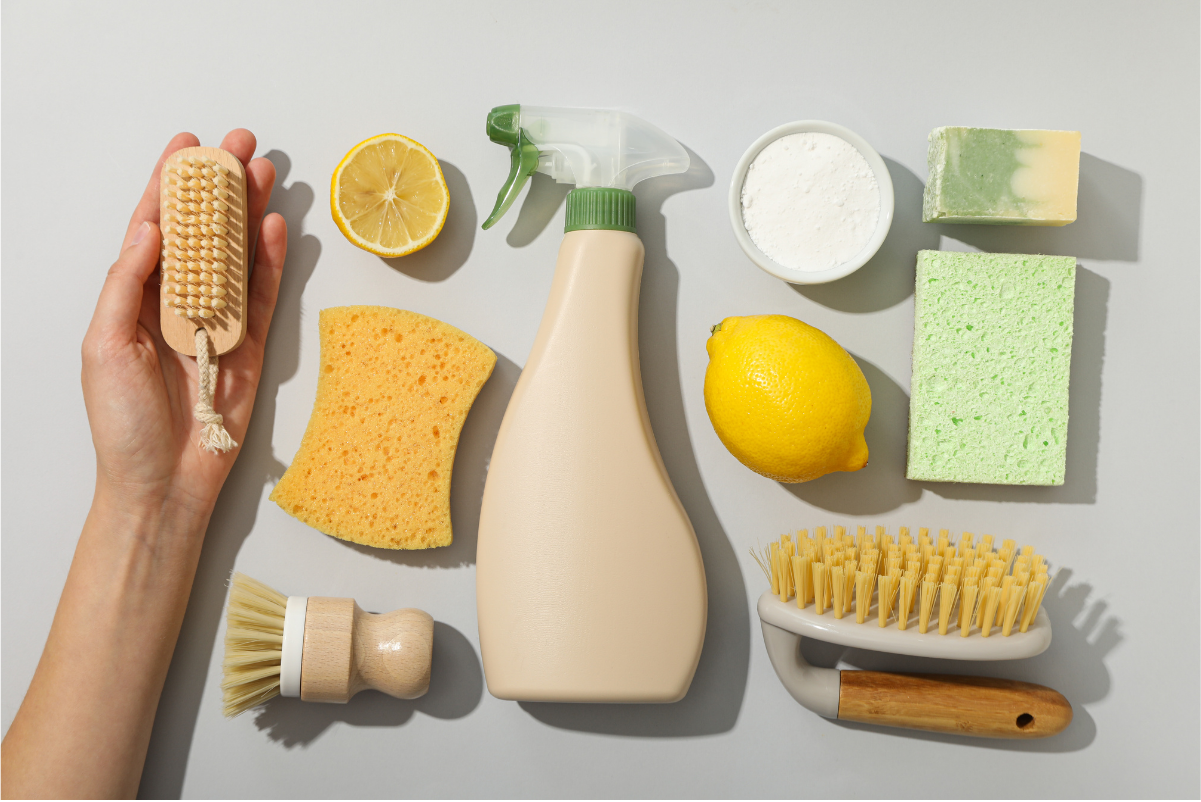
Harmful chemicals in household products have become something I’ve paid much more attention to over the past few years. I’ve gradually reduced synthetic fragrances and harsher cleaning products, started making some of my own cleaners, and become far more conscious of the ingredients in the personal-care products I use too.
But a new study published in August 2026 made me think about something an ingredient label can’t necessarily tell us – what else might be present in the finished product.
Researchers in the US tested 113 personal-care and household products and found that almost every product contained at least one chemical that wasn’t disclosed on the label. More concerningly, many contained undisclosed chemicals that the researchers classified as harmful or potentially harmful within their hazard-screening framework.
Those findings sound alarming, but there is some important context. This was a relatively small US study, it doesn’t tell us that the same percentages apply to products sold in the UK, and detecting a potentially harmful chemical doesn’t automatically mean a product poses a health risk at the level we’re exposed to.
So rather than seeing this as another reason to be frightened of everything in our homes, I think it’s an opportunity to look more closely at what the research actually found, how much we can really learn from a product label, and the simple ways we can reduce unnecessary chemical exposure where it feels practical.
This post may contain affiliate or referral links. If you make a purchase through one of these links, I may earn a small commission or receive a benefit, at no extra cost to you. I only share products and services I genuinely use, trust or believe may be helpful
What did the new study find?
The study, published in ACS Environmental Health in August 2026, analysed 113 personal-care and household products sold in the US. Rather than relying only on the ingredients listed on the packaging, researchers used nontargeted chemical analysis to investigate what was actually detectable in the finished products.
Across the products tested, researchers detected 3,141 chemical features and identified 303 chemicals with varying levels of confidence.
Some of the most striking findings were:
- 98% of the products contained at least one chemical that wasn’t disclosed on the product label.
- 85% contained at least one undisclosed chemical classified by the researchers’ hazard framework as harmful or potentially harmful.
- 57.5% failed the researchers’ contamination assessment.
- Of 27 products initially given the researchers’ best “Go” rating based on their ingredient labels, 59% subsequently failed when the finished products were tested.
- 26% contained chemicals that contradicted at least one manufacturer claim.
One important detail is that this wasn’t primarily a study of household cleaners. Only 11 of the 113 products were household cleaning products. The study also included a much wider range of personal-care products, such as shampoos, moisturisers, deodorants, sunscreens and toothpaste.
For me, one of the most interesting findings is what happened to some of the products that looked good based on their labels. If a product can appear to be a better choice from its ingredient list but receive a very different assessment once the finished product is analysed, it raises an important question: how much can an ingredient label really tell us?
Do harmful chemicals in household products mean they are dangerous?
This is where some important context is needed. The study looked at chemical hazard, which isn’t the same thing as determining the actual health risk from using a product.
A substance may have properties that make it potentially harmful, but our individual risk also depends on factors such as how much we’re exposed to, how often we’re exposed, how the substance enters the body and how much is actually absorbed.
The researchers themselves acknowledge this limitation. Their assessment wasn’t designed to tell us whether using a particular shampoo, moisturiser or household cleaner will cause harm.
It’s also important not to apply the headline figures to every product on the market. This was a relatively small, deliberately selected sample of 113 products sold in the US. Finding potentially harmful undisclosed chemicals in 85% of those products does not mean that 85% of the products in our homes are harmful.
For me, that distinction doesn’t make the findings unimportant. Instead, it reinforces why I prefer a sensible, precautionary approach. We don’t need to become frightened of every ingredient or throw everything in our cupboards away, but where it’s easy to reduce unnecessary exposure, simplify the products we use or make more informed choices, I think that’s worth considering.
Does this study apply to products in the UK?
Because this research was carried out using products sold in the US, we can’t assume that the same results would be found if researchers tested 113 products from UK shelves.
Great Britain has its own rules governing cosmetics. Products must undergo a safety assessment before being placed on the market, have a designated Responsible Person and meet requirements around notification and ingredient labelling.
However, an ingredient list doesn’t necessarily provide a complete picture of every chemical that could be detected in the finished product. For example, fragrance mixtures can appear under terms such as “parfum” or “aroma”, while impurities in raw materials aren’t necessarily treated as cosmetic ingredients that must be individually listed.
There are also several possible reasons why a chemical might be detected without appearing separately on a label. It could be an impurity or contaminant, part of a botanical ingredient, or one component within a more complex fragrance mixture.
That’s why I still think this US research matters to those of us in the UK. It doesn’t prove that British products would produce the same results, but it raises a much broader question about the limits of relying on ingredient labels alone.
For me, the fact that something meets the requirements to be legally sold doesn’t automatically mean it’s a product I personally want to use every day. Equally, that doesn’t mean conventional products are inherently dangerous. It’s about having as much information as possible and deciding where reducing unnecessary exposure feels worthwhile for you.
What can we actually do to reduce unnecessary exposure?
Research like this can leave you wondering what you’re supposed to buy if even an ingredient label can’t tell you everything. I don’t think the answer is to become suspicious of every product we use. Instead, I’ve found it more helpful to focus on the things I can reasonably control.
One of the biggest changes I’ve made is simply using fewer products. This applies to my skincare as much as my cleaning cupboard. I used to have a much more complicated skincare routine with lots of different products, whereas now I keep it very simple. I often use natural oils for cleansing and moisturising, I’m careful about the skincare brands I choose, and I even make my own simple oil cleanser. I’ve shared more about the natural skincare swaps I’ve made if you’d like to see how I’ve simplified my routine.
I’ve taken a similar approach around my home. I make some of my own cleaning products, choose simpler alternatives when I buy them, avoid heavily fragranced products and don’t feel that I need a different cleaner for every surface or job.
This is something I feel quite strongly about because I’ve genuinely noticed a difference since reducing products such as bleach, harsh cleaners and synthetic fragrances in my own home. I notice it particularly now when I’m somewhere they’re being used – whether that’s when I’m away or visiting someone else’s home. That’s my personal experience rather than evidence that everyone will react in the same way, but it’s one of the reasons reducing unnecessary chemical and fragrance exposure remains important to me.
Some other practical steps worth considering are choosing fragrance-free products where possible, looking for shorter and clearer ingredient lists, ventilating rooms while cleaning, and questioning whether you actually need every product you’re using.
None of these choices can eliminate chemical exposure, nor does “natural” automatically mean safer. Essential oils, for example, are themselves complex mixtures of naturally occurring chemicals and need to be used appropriately.
For me, it’s less about trying to create a perfectly “toxin-free” life and more about reducing unnecessary exposure where it’s practical, while still being able to live normally.

What about ‘natural’ and ‘non-toxic’ cleaning products?
One of the things this study has made me more cautious about is treating words such as “natural”, “organic” or “non-toxic” as guarantees. They can be useful starting points, but the research showed that products that looked like good choices based on their labels didn’t always perform as expected when the finished products were analysed.
That doesn’t mean I’ve stopped buying cleaning products altogether. Sometimes making your own simply isn’t convenient, and there are still products I personally feel more comfortable choosing.
When I don’t make my own cleaner, Bio-D is one of the brands I currently use. I like that its All Purpose Sanitiser is made in the UK and has a relatively simple published ingredient list. But I wouldn’t describe it – or any other product – as guaranteed “toxin-free” because I don’t have independent finished-product testing that could support that claim.
I also use some Ecover products, although I wouldn’t automatically put everything made by a particular brand into the same category. Formulations vary from product to product. For someone particularly looking to avoid added fragrance, for example, Ecover’s Zero range may be more relevant than some of its standard fragranced products.
Ultimately, I think it’s more useful to look at individual products than rely entirely on a brand name or the claims on the front of the bottle. Simpler formulations, fragrance-free options and greater ingredient transparency are all things I now look for when deciding what I bring into my home.
Why I still like making some of my own cleaning products
One of the reasons I enjoy making some of my own cleaning products is simply that it gives me more control over what I’m intentionally bringing into my home. A basic homemade cleaner can contain just a handful of ingredients, and I know exactly what I’ve added.
I’ve shared several of the recipes I use in my toxic-free cleaning DIY recipes article, including simple alternatives for everyday cleaning around the home.
A book I’ve also found really helpful is Nancy Birtwhistle’s Clean & Green. It’s where I discovered many of the ideas and recipes that encouraged me to experiment with making more of my own household products, and it’s a resource I still think is useful if you’d like to take this further.
Of course, homemade doesn’t automatically mean harmless. Ingredients still need to be used appropriately, and natural substances such as essential oils can cause irritation or other problems when they’re used incorrectly. But for me, making some products myself is less about trying to achieve a completely chemical-free home and more about simplicity, transparency and having greater control over the ingredients I choose to use.
What I’m taking away from this research
For me, the biggest takeaway from this study isn’t that we should be frightened of everything in our bathroom cupboards or under the kitchen sink. It’s that an ingredient label, while useful, may not always tell us the whole story.
I don’t think it’s realistic – or necessary – to try to avoid every chemical we’re exposed to. But I do think there is value in being more considered about the products we use frequently, particularly when there are simple changes we can make without making life difficult.
That’s the approach I’ve gradually taken in my own home and with my personal care. I use fewer products, avoid heavy synthetic fragrances where I can, choose simpler formulations, make some things myself and continue to learn more about the products I use.
This study hasn’t made me want to throw everything away. If anything, it has reinforced why I prefer a precautionary but practical approach: reduce what I don’t need, make informed choices where I can, and remember that words such as “natural” or “non-toxic” on the front of a bottle aren’t the same thing as knowing exactly what’s in the finished product.
We may not be able to control every exposure in everyday life, but we can make thoughtful choices about the ones we can control – and for me, that’s enough.
Sources & Further Reading
- Schultz K, Rochester JR, Lathrop MK, et al. (2026). Hidden Hazards: Nontargeted Chemical Analysis Reveals Widespread Contaminants and Mislabeling in Personal Care and Cleaning Products. Environment & Health, American Chemical Society.
- Making cosmetic products available to consumers in Great Britain – Office for Product Safety and Standards and Department for Business and Trade.
- Consumer products: cosmetics – Office for Product Safety and Standards.


Leave a Reply